EvoBNE is a computational discovery engine for unexplored protein sequence space. It uses physical structure as a search-space prior, generates candidate sequences under structural constraints, and subjects them to unusually stringent novelty and biophysical analysis.
A 200-residue protein has 20^200 possible sequences. No experimental program, and no brute-force computational search, can enumerate that space.
Most protein discovery therefore starts from what biology has already revealed: known sequences, homologous families, conserved domains, established folds, or recognizable motifs. Those methods are extraordinarily useful, but they naturally favor regions of sequence space connected to known biology.
EvoBNE targets a different problem: finding rare candidates that are physically constrained yet have no convincing relationship to known proteins.
A random sequence can be novel. That does not make it useful. A useful discovery candidate has to survive several independent questions at once.
The sequence must be generated under a physical prior rather than selected arbitrarily from 20^200 possibilities.
Sequence, profile, motif and structural searches are used to look for convincing relationships to existing biological space.
Disorder, composition and molecular simulations turn a raw sequence into a measurable physical and ensemble-level profile.
EvoBNE uses a structural representation as a computational anchor. Structure-conditioned sequence design then searches a constrained region of sequence space rather than attempting to enumerate sequence space directly.
The starting structure is a search-space compression device, not a claim that an intrinsically disordered protein possesses that single fixed structure in its biological state.
Candidate evo_c137 illustrates the type of computational dossier produced by the Atlas. The numbers below are taken directly from its Atlas record.
376 AA · 29.698 kDa · pI 7.88 · computationally qualified dark candidate
The candidate does not merely have a novel-looking sequence. It has an evidence trail across sequence, structure, motif and disorder analyses.
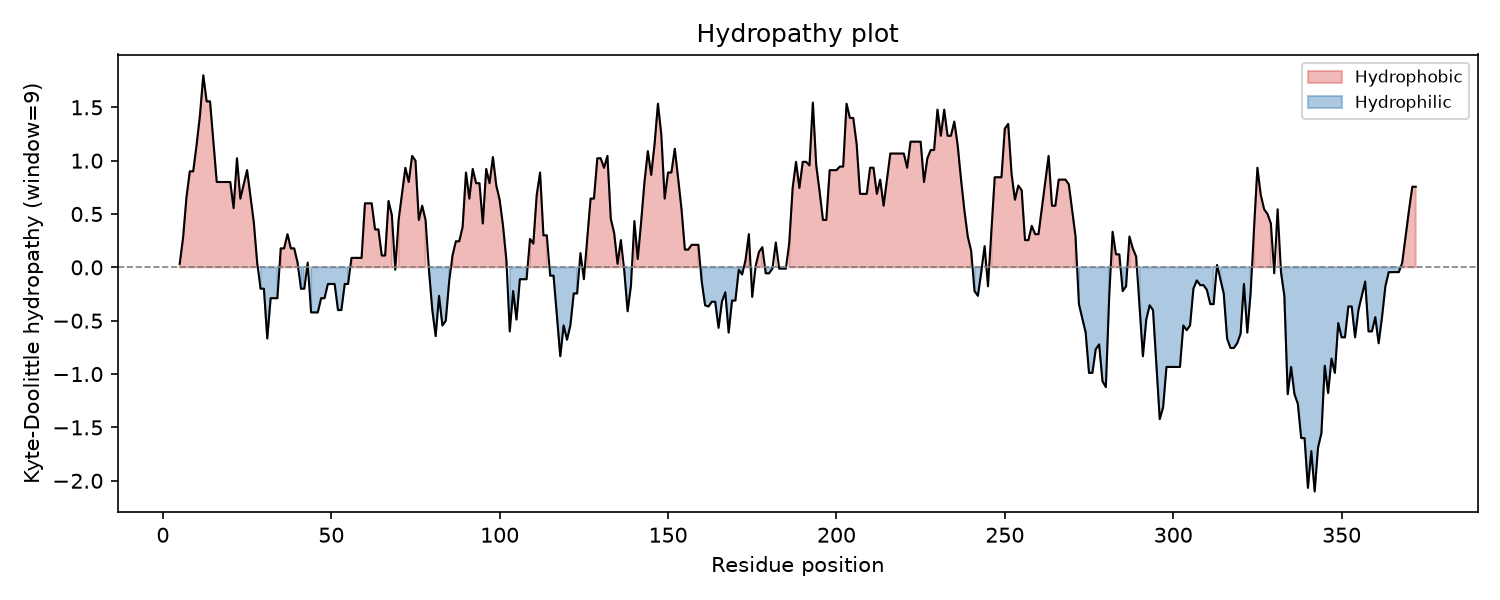
Hydropathy profile for evo_c137. The plot is one component of the candidate's broader physical fingerprint; it is not presented as proof of a particular material function.
Not claimed: allergen safety, GRAS status, immunogenicity, expression or production yield. No data package for these has been supplied yet.
EvoBNE does not require broad coverage of sequence space to create value. A single strong orphan can be worth pursuing. When multiple generated candidates are related to one another but remain disconnected from known biological families, the discovery becomes more powerful.
No convincing relationship is detected in the reference sequence and structural databases searched.
Related candidates can form a sequence or structural family, creating a local design landscape that did not appear in the external databases.
This creates an important discovery unit: not simply a protein, but a previously unrecognized region of protein space that can contain related candidates with different predicted physical properties.
EvoBNE is the discovery engine. EvoBNE Atlas is the library of candidates that survive the process.
Sequence, generation context, structural prior and discovery record.
Sequence, profile, motif and structural search evidence documenting the candidate's relationship, or lack of relationship, to known space.
Disorder, charge, pI, hydropathy, composition and related sequence-derived descriptors.
Conformational statistics, Rg, contacts, scaling behavior and simulation diagnostics where applicable.
The value is not the cost of generating a sequence. The value is the discovery process that makes an otherwise inaccessible candidate experimentally actionable.
Customers can access qualified Atlas candidates and obtain an exclusive evaluation option for a defined period and application. The customer then decides whether the candidate deserves synthesis and experimental development.
This creates an asymmetric discovery model: a relatively small evaluation commitment can provide access to a candidate whose downstream value, if experimental validation succeeds, may be much larger.
EvoBNE turns physical priors, structure-conditioned sequence discovery, stringent novelty screening and ensemble characterization into a practical discovery system for proteins outside recognizable biological space.
EvoBNE discovers. EvoBNE Atlas qualifies. Experimental science decides what comes next.